If you pasted a job description into ChatGPT, asked it to "tailor my resume with strong action verbs," and still heard silence after 40 applications—you are not alone.
In late 2026, corporate job postings routinely draw 250+ applications per opening globally (and 800+ for tech roles in Bengaluru, Hyderabad, Pune, and remote US hubs). To survive the flood, recruiters stopped reading resumes linearly from top to bottom. Instead, they rely on semantic Applicant Tracking Systems (ATS) layered on top of Workday, Greenhouse, Lever, iCIMS, and Oracle Taleo—followed by a brutal 6-second human skim tuned to spot AI filler on sight.
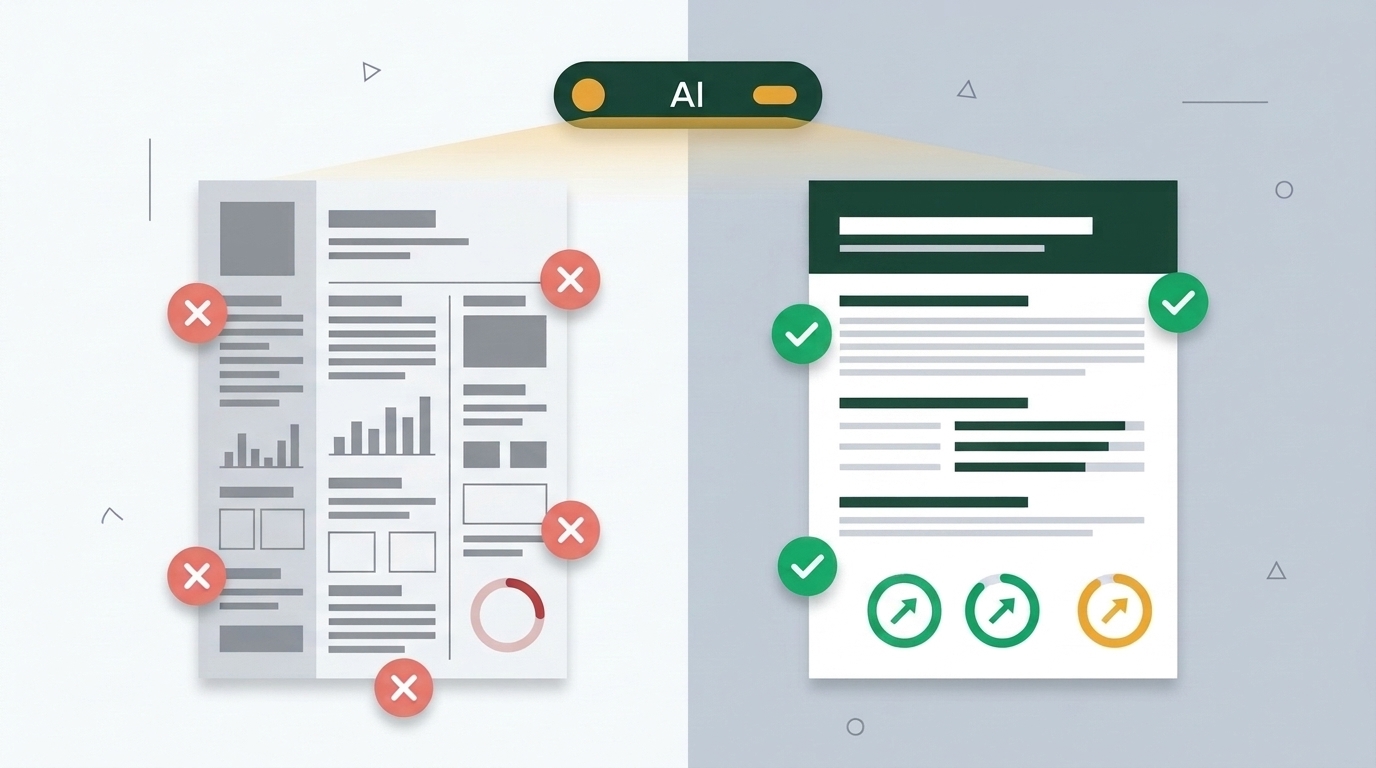
Here is the uncomfortable truth: enterprise ATS platforms do not use secret "AI text detectors" to reject ChatGPT resumes. You aren't being disqualified because software flagged a hidden watermark. You are being rejected because raw ChatGPT output fails semantic relevance scoring, triggers recruiter cliché fatigue, and—when paired with fancy multi-column templates—breaks structural text extraction before a human ever sees your name.
Let's break down how 2026–2027 semantic ATS ranking actually works and how to rebuild your resume so both vector search engines and exhausted hiring managers put you in the top 5%.
The "Sea of Sameness": Why Hiring Managers Trash Generic AI Resumes
Every candidate now has access to the exact same frontier LLMs. When thousands of applicants prompt ChatGPT or Claude with "make my resume sound more professional," they submit nearly identical paragraphs packed with polished, empty corporate fluff.
Recent hiring research across major talent platforms reveals just how severe AI resume fatigue has become heading into 2027:
- 80% of hiring managers report they can immediately spot standardized AI-written phrasing and templated formatting, according to Resume Genius survey data—with 69% saying resumes have become noticeably more generic and harder to tell apart.
- 62% of hiring managers state that unpersonalized, AI-generated applications are significantly more likely to trigger immediate rejections because they lack genuine context and verifiable substance, according to Resume Now research.
- 90% of employers worry they have mistakenly screened out real, qualified candidates simply because heavy AI templating made those resumes look automated, spammy, or indistinguishable from mass-apply bots, per Greenhouse hiring data.
Hiring managers aren't anti-AI—they are anti-vagueness. When your summary opens with "Results-driven synergistic professional with a proven track record of leveraging dynamic solutions," a recruiter's eyes glaze over in under two seconds.
The ChatGPT Cliché Blacklist vs. High-Signal Language
Generic LLM prompts gravitate toward high-probability corporate filler verbs and adjectives that carry zero technical or business signal. Replace these red-flag phrases immediately:
| ❌ Generic ChatGPT Cliché (Instant Skim Fatigue) | Why It Hurts Your Rank | ✅ High-Signal Replacement Pattern |
|---|---|---|
| "Results-driven synergistic professional" | Zero domain nouns; reads like an unedited ChatGPT header. | "Backend Engineer (Go, Kafka, PostgreSQL) scaling payment pipelines to 18K RPS" |
| "Spearheaded cross-functional synergy" | Explains neither what you built nor which teams/systems changed. | "Coordinated API contract migration across 3 mobile and billing squads, cutting checkout failures by 41%" |
| "Proven track record of operational excellence" | Empty claim with no metric, tool, or constraint. | "Automated zero-downtime Kubernetes rollouts via GitHub Actions and ArgoCD across 14 microservices" |
| "Leveraged cutting-edge technologies to optimize workflows" | Hides the actual tech stack from both semantic parsers and tech leads. | "Replaced batch cron jobs with Redis Streams and FastAPI async workers, dropping report latency from 9m to 18s" |
| "Passionate, detail-oriented team player" | Subjective self-praise that consumes prime above-the-fold space. | "Authored 94% integration test coverage in Playwright and led weekly architecture design reviews" |
Semantic ATS vs. Keyword Stuffing: How 2026 Screening Really Works
To beat modern screening, you have to understand what happens inside an enterprise recruiting pipeline the moment you click Submit. Modern ATS hiring operates as a Two-Gate System:
Gate 1: The Structural Parser (Exact Text Extraction)
Before any AI ranking model scores your qualifications, a parser (such as Workday's extraction engine, Greenhouse's structured profile builder, or legacy Textkernel/Sovren parsers inside Taleo) converts your PDF or DOCX into structured database fields: Name, Email, Job Titles, Employers, Dates, Skills, and Education.
If your layout uses two columns, text boxes, Canva sidebars, or graphical skill bars, Gate 1 scrambles your text stream. Your React skills merge with your graduation year, job dates disappear, and your structured profile looks half-empty.
Gate 2: The Semantic AI Layer (Vector Embeddings & Context)
In 2020, legacy Boolean ATS filters hunted for exact string matches. If a job post asked for "Customer Relationship Management" and you wrote "Enterprise Account Management", you risked scoring zero.
In 2026 and 2027, modern ATS stacks—such as Workday Recruiting paired with AI talent-intelligence layers like HiredScore, or semantic talent-rediscovery layers on top of Greenhouse and Lever—use Natural Language Processing (NLP) and vector embeddings to score meaning, context, and entity relationships.
Here is how semantic scoring rewards real engineering/business depth and punishes keyword stuffing:
| Screening Approach | Legacy Keyword ATS (2018–2021) | Semantic ATS Engines (2026–2027) |
|---|---|---|
| How Skills Are Matched | Exact string match ("Kubernetes" only matches "Kubernetes"). | Understands relationships and synonyms ("EKS" + "Helm" + "HPA" reinforces "Kubernetes orchestration"). |
| Response to Keyword Stuffing | Often fooled by hidden white text or skill dumps at the bottom. | Evaluates contextual entity density—isolated buzzwords without surrounding action verbs and outcomes rank poorly. |
| Role Progression & Recency | Flat scan across the entire document. | Weights recent experience higher and checks whether skills appear inside verifiable work bullets, not just a tag list. |
| Effect of ChatGPT Fluff | Neutral if keywords were forced in. | Negative rank dilution—vague prose reduces semantic similarity to specific, technical job descriptions. |
| What Happens When You Score Low | Usually stuck in unreviewed keyword buckets. | Ranked #185 out of 250 applicants—recruiters shortlist only the top 10–15 profiles, effectively "auto-rejecting" the rest. |
Modern platforms like Greenhouse explicitly emphasize structured human scorecards rather than autonomous robot rejections. Yet ranking 185th out of 250 candidates produces the exact same outcome: zero interview calls.
Want to see which exact skills and semantic clusters your resume is missing before you apply? Paste your resume and target job description into the Free PrepHit ATS Resume Scanner—100% free with zero login required.
Single-Column ATS Parsing Rules: Workday vs. Greenhouse vs. Taleo
You can write the sharpest, most authentic resume bullets in the industry and still lose at Gate 1 if your visual template breaks enterprise parsers.
Most parsers read PDF documents linearly from left to right, top to bottom across the entire page width. Whenever you introduce a two-column split, floating sidebar, or layout table, the parser stitches the left column's job title straight into the right column's skill list, creating gibberish.
How the Big 3 Enterprise ATS Platforms Parse Your Resume
| ATS Platform | Parsing Behavior & Strictness | What Breaks It Most Often | How to Guarantee a 100% Clean Parse |
|---|---|---|---|
| Workday Recruiting | Strict, conservative field mapping into rigid HCM employment history blocks. | Two-column layouts, tables, custom date formats ('23–'25), and multi-line job headers. | Single-column layout; standard MM/YYYY – MM/YYYY dates; always verify the auto-populated review screen before submitting. |
| Greenhouse | Structured workflow ATS with cleaner modern PDF parsing, feeding recruiter scorecards. | Text boxes, vector-outlined design exports (Canva/Figma), header/footer contact text, and skill rating bars. | Standard text-selectable PDF or .docx; put contact info in the main body, never inside Word headers/footers. |
| Oracle Taleo | Legacy enterprise compliance engine with strict knockout rules and fragile linear extraction. | Non-standard headings ("Where I've Added Value"), icons, tables, and creative formatting. | Strictly chronological format; exact standard headings (Work Experience, Education, Skills); clean .docx or vector PDF. |
The 6 Non-Negotiable Formatting Rules for 2026
- Commit to a Strict Single-Column Layout: Every section must stack vertically from top to bottom. Save two-column designer templates for creative portfolios sent directly to a hiring manager over email—never upload them to an ATS portal.
- Banish Tables, Text Boxes, and Graphic Skill Bars: An icon graphic showing "Python: 4/5 stars" or "SQL: 85%" parses as blank whitespace. List your technical stack in plain, comma-separated text grouped by category (e.g.,
Languages:,Frameworks:,Cloud & Data:). - Use Exact Standard Section Headings: ATS classifiers map content using predictable section labels. Stick to
Professional Summary,Technical Skills(orCore Competencies),Work Experience,Projects,Education, andCertifications. - Never Put Contact Info in Document Headers or Footers: Many parsers skip top-margin headers and bottom-margin footers entirely, stripping out your phone number, email, GitHub, and LinkedIn URLs. Keep your name and links in the main document flow.
- Export Text-Selectable Vector PDFs (or Clean
.docx): Always verify that you can drag your cursor across every word in your PDF and copy-paste it into Notepad. Never upload flattened image PDFs exported from Canva, Photoshop, or scanned printouts. - Stick to Standard, Web-Safe Typography: Use clean sans-serif or serif fonts like Inter, Roboto, Calibri, Arial, Helvetica, or Georgia (10–11.5pt body text, 14–16pt section headings) with standard round bullets (
•). Avoid custom ligatures or icon fonts that turn into□boxes.
Don't fight Word margins or broken PDF exports by hand. Generate a parser-tested, single-column ATS resume directly inside the PrepHit Free AI Resume Builder—instant browser access, no login required.
CAR & STAR Outcome-Based Bullets: How to Beat Semantic Scoring
Once your single-column formatting passes Gate 1, your bullet points determine whether Gate 2's semantic engine—and the human hiring manager—ranks you in the top 5%.
Generic ChatGPT bullets fail because they describe generic duties ("Responsible for managing backend services") or invent hollow, untethered percentages ("Improved efficiency by 30%"). Semantic models and technical reviewers look for evidence density: the specific problem, the exact tools/decisions you made, and the measurable business or system impact.
Use the CAR / STAR Outcome Formula:
[Strong Action Verb] + [Challenge / Specific System & Tools Used] + [Quantified Result & Scale]
Notice how CAR (Challenge → Action → Result) and STAR (Situation/Task → Action → Result) force every bullet to carry concrete domain entities—turning vague fluff into high-density proof.
Before vs. After Rewrites Across 4 High-Demand Roles
1. Backend / Software Engineer
❌ ChatGPT Generic: "Spearheaded the optimization of backend microservices, leveraging innovative caching methodologies to drive performance excellence and enhance user satisfaction."*
✅ CAR/STAR Semantic: "Eliminated checkout database bottlenecks (Challenge) by introducing a Redis cache-aside layer and composite PostgreSQL indexes across Node.js order services (Action), cutting p99 API latency from 640ms to 78ms during 15K concurrent user flash sales (Result)."*
2. Frontend / Full-Stack Developer
❌ ChatGPT Generic: "Results-driven developer who collaborated with cross-functional teams to build dynamic, user-friendly web applications using modern React frameworks."*
✅ CAR/STAR Semantic: "Resolved slow landing-page conversions on mobile networks by migrating 14 legacy CSR pages to Next.js App Router Server Components, TypeScript, and WebP lazy-loading, improving LCP from 3.8s to 1.1s and lifting onboarding completion by 19%."*
3. Product / Data Analyst
❌ ChatGPT Generic: "Leveraged data-driven insights and stakeholder synergy to streamline reporting workflows and empower strategic executive decision-making."*
✅ CAR/STAR Semantic: "Replaced 6 hours of weekly manual Excel reconciliation by building automated SQL / dbt transformations in BigQuery paired with a Looker Studio churn analytics report, uncovering a billing-flow drop-off that recovered ₹18L ($22K) in quarterly ARR."*
4. Fresher / Final-Year Graduate (No Corporate Experience Yet)
❌ ChatGPT Generic: "Passionate computer science graduate with strong problem-solving skills who built an innovative AI chatbot project to demonstrate full-stack expertise."*
✅ CAR/STAR Semantic: "Built a RAG-powered campus placement Q&A assistant using Python, FastAPI, and pgvector over 450+ company interview archives, adding strict JSON citation checks that cut hallucinated answers to under 3% across 120+ student beta tests."*
Quick Reference Table: Turning Weak Duties into Semantic Wins
| Role | ❌ Weak / AI-Fluff Bullet | ✅ Outcome-Based CAR/STAR Rewrite | Why Semantic ATS Scores It Higher |
|---|---|---|---|
| DevOps / Cloud | "Managed AWS infrastructure and streamlined CI/CD deployment processes." | "Automated zero-downtime AWS EKS deployments via Terraform and GitHub Actions, shrinking release windows from 50 mins to 7 mins across 12 services." | Pairs AWS EKS + Terraform + GitHub Actions + concrete deployment-speed delta. |
| QA / SDET | "Executed manual and automated testing to ensure high software quality." | "Engineered a Playwright end-to-end regression suite integrated into Jenkins CI, catching 38 pre-release payment bugs and cutting hotfix rollbacks by 65%." | Connects testing tool (Playwright) with CI automation (Jenkins) and defect reduction. |
| Product Manager | "Drove product roadmap initiatives and maximized cross-functional alignment." | "Prioritized a 3-step self-serve onboarding flow after funnel analysis across 40K MAUs, boosting Day-7 activation from 24% to 37% in one quarter." | Signals real PM craft (funnel analysis, MAU, Day-7 activation) without buzzwords. |
| Marketing / Growth | "Championed digital marketing campaigns to elevate brand awareness and ROI." | "Restructured Google Ads and Meta retargeting cohorts with landing-page A/B tests, lowering CAC by 28% while scaling qualified demo leads by 340/month." | Demonstrates measurable acquisition metrics (CAC, A/B testing, demo leads). |
How to Use AI to Write Your Resume Without Sounding Like ChatGPT
You do not need to abandon AI tools to pass 2026 screening. You just need to switch from generative fluff prompting to structured, truth-grounded editing:
- Feed Raw Facts First, Never Blank Prompts: Never tell ChatGPT "write 4 bullets for a Senior Product Manager." Instead, paste messy notes from your actual sprint tickets, pull requests, or performance reviews ("fixed memory leak in Flutter image grid, dropped OOM crashes from 4% to 0.3% on 2GB RAM Android phones").
- Ban Specific Verbs & Adjectives: Explicitly instruct any AI assistant: "Do not use the words spearheaded, leveraged, synergistic, dynamic, results-driven, proven track record, or operational excellence."
- Never Accept Invented Numbers: If an AI drafts "increased efficiency by 30%" when you never measured 30%, delete the number immediately. Replace it with real scope you can defend in an interview ("across 4 regional warehouses", "eliminating 3 manual approval steps", "for 12 enterprise clients").
- Read Every Bullet Out Loud: If you wouldn't say a sentence out loud to an engineering manager over coffee, cut the corporate adjectives until it sounds like an actual human explaining their work.
The 5-Step Pre-Submission Audit Checklist (Run This in 5 Minutes)
Before you submit your next application to Workday, Greenhouse, Taleo, or LinkedIn Easy Apply, run through this five-step audit:
Step 1: The Ctrl+A Plain-Text Copy Test (Gate 1 Check)
Open your exported PDF, pressCtrl+A (or Cmd+A), copy everything, and paste it into a blank Notepad or TextEdit window.
Step 2: The ChatGPT Cliché Purge (Ctrl+F Sweep)
Search your resume text for the top AI giveaway words: synergy, synergistic, results-driven, spearheaded, leveraged, dynamic, proven track record, passionate, revolutionized, and detail-oriented. Delete every occurrence and replace it with what you actually built, shipped, sold, or fixed.
Step 3: The CAR/STAR Entity & Proof Check
Inspect the top three bullets under your two most recent roles. Does every single bullet contain:Architected, Migrated, Automated, Reduced, Negotiated)?Kafka, React 19, SOX compliance, PostgreSQL, HubSpot)?Step 4: The Semantic JD Alignment Scan
Compare your resume directly against the target job description—not to cram identical words ten times, but to verify that your core skill clusters match what the role actually demands. Missing a critical dealbreaker skill (e.g.,"Terraform" or "TypeScript" when you actually used it) will bury your semantic vector score. Run a 3-second check with the PrepHit Free ATS Resume Scanner to spot missing dealbreaker keywords and cliché risks instantly—with no login required.
Step 5: The Clean Build & Portal Verification Pass
Export a clean, text-selectable single-column PDF (or.docx when requested) using a parser-verified layout from the PrepHit Free AI Resume Builder. Then, when uploading to Workday or Taleo, never skip the auto-populated review screen—double-check that your job titles, company names, and graduation dates landed in the right fields before clicking final submit.
Frequently Asked Questions (FAQ)
Do Workday, Greenhouse, or Taleo reject resumes using AI detectors?
No. Major enterprise ATS platforms do not run AI-content detectors or perplexity checks to auto-delete ChatGPT-written resumes. Instead, unedited ChatGPT resumes lose because they rely on vague clichés that score poorly in semantic relevance matching and look identical to hundreds of other spam applications during human recruiter review.Should I submit a PDF or a .docx file in 2026?
A text-selectable vector PDF (generated directly by a clean ATS resume builder, Google Docs, or Word—never flattened image exports from Canva or Photoshop) is accepted by virtually all modern ATS systems including Greenhouse and Lever and preserves your exact layout for human reviewers. If an older Taleo or corporate portal explicitly requests .docx, upload a clean single-column .docx file.
Can I still use a two-column resume if I apply via email or startup founders?
When emailing a startup founder or hiring manager directly (where your PDF lands straight in Gmail rather than an ATS parser), a minimalist design is fine—though clean single-column layouts still scan faster during a 6-second skim. Whenever you apply through an online job board, career portal, Workday, Greenhouse, iCIMS, or Taleo, always use a single-column layout.Stop Guessing—Scan and Rebuild Your Resume Free in 60 Seconds
You don't need to pay for expensive resume rewriters or create yet another account just to check why recruiters aren't calling back. PrepHit gives you instant browser tools—100% free with zero login required:
- 🔍 [Scan Your Resume Against Any Job Description (
/analyze)](/analyze): Run our Free ATS Resume Scanner (no login required) to uncover your semantic match score, missing dealbreaker keywords, and AI cliché traps in seconds. - 📄 [Build a Single-Column ATS Resume (
/resume)](/resume): Use our Free AI Resume Builder (no login required) to craft crisp, CAR/STAR outcome-based bullets on parser-tested single-column templates built to pass Workday, Greenhouse, and Taleo cleanly.
Stop Getting Filtered. Fix Your Resume in 2 Minutes.
Don't apply with an unparsed resume. PrepHit scans your document against real 2026 recruiter ATS filters, highlights missing keywords, and gives you single-column ATS templates for instant export.