If your PCOS symptoms—late afternoon sugar crashes, bloating, jawline acne, or stubborn lower-belly weight—seem to flare up every November through February, you are not imagining it.
Indian winters change both what ends up on our plates and how our hormones process glucose. Heavy comfort carbs like multiple stuffed parathas, sweet gajak, and extra cups of sugary masala chai collide with shorter daylight hours and less movement, pushing fasting insulin higher and triggering ovarian androgen production.
The solution is not starving on cold western salads or banning roti and rice forever. Instead, you can calm insulin spikes and keep your body warm with the 50-25-25 Indian PCOS Plate Rule, smart food sequencing, the right winter millet choice (Ragi vs. Jowar vs. Bajra), and a targeted Indian Winter Seed Cycling schedule.
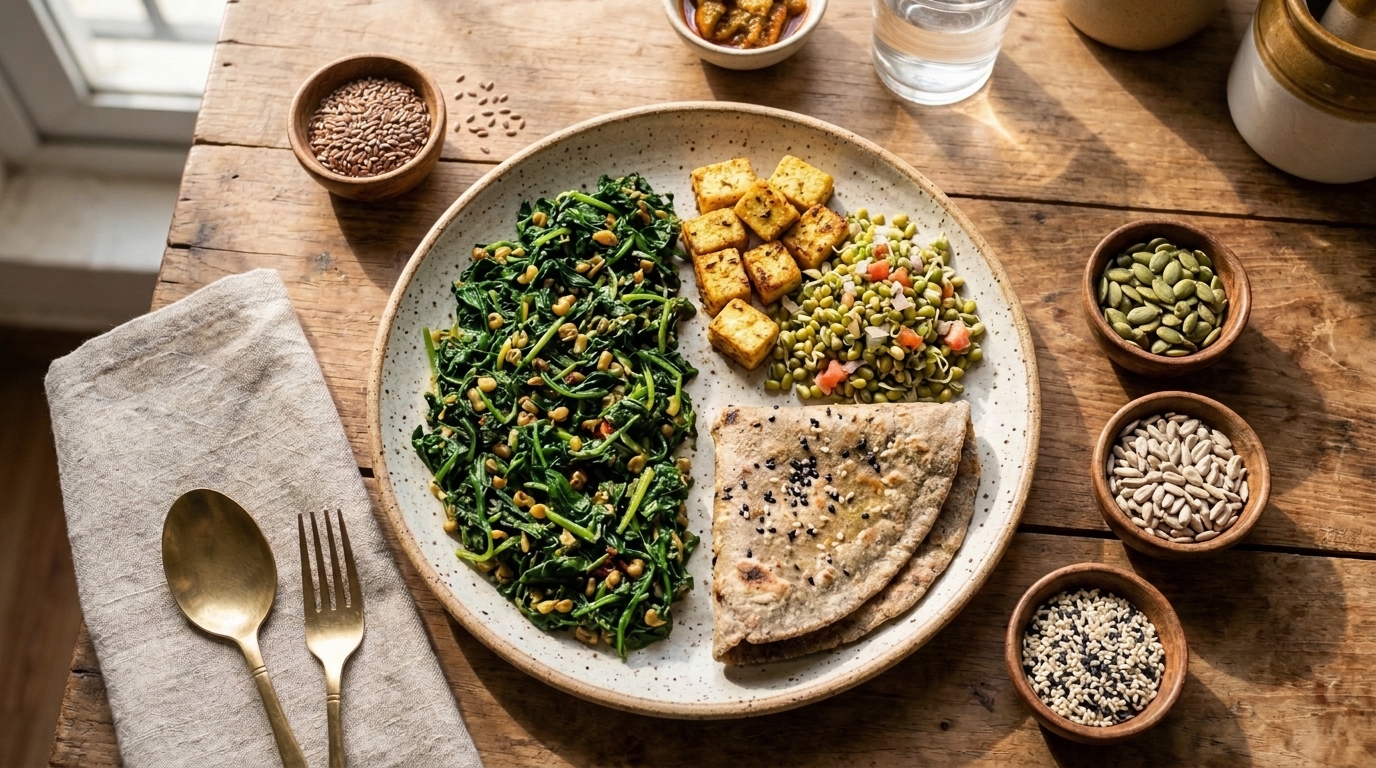
Why Winter Slows Metabolism & Worsens Cravings in PCOS
To fix winter PCOS flare-ups, it helps to understand why cold weather hits insulin-resistant bodies harder:
- Drop in Vitamin D & Insulin Sensitivity: Shorter winter days and indoor routines cause Vitamin D levels to dip across Indian cities. Low Vitamin D directly worsens insulin resistance and disrupts follicular maturation in PCOS.
- Lower Daily Movement (NEAT): Chilly mornings and early sunsets quietly cut down non-exercise activity—fewer evening walks, longer hours under blankets, and more sedentary desk time—leaving skeletal muscles less active at clearing blood glucose. Serotonin Dip & 4 PM Carb Cravings: Reduced sunlight lowers brain serotonin while bumping up melatonin early, driving intense late-afternoon cravings for fast energy (biscuits, namkeen, halwa*, and sweetened tea).
- Cortisol & Thyroid Slowdown: When you skip balanced protein at breakfast and rely on refined carbs to stay warm, blood sugar swings spike cortisol. Elevated cortisol slows peripheral thyroid hormone conversion (T4 to active T3) and signals the body to store visceral fat around the waistline.
Winter PCOS cravings are driven by blood-sugar volatility and low Vitamin D—not weak willpower. Warm, fiber-first, protein-anchored Indian meals stabilize insulin within days.
The 50-25-25 Indian PCOS Plate Rule
Forget weighing every single almond or cooking separate Western meals. Use the 50-25-25 Plate Rule every time you build lunch or dinner with everyday Indian kitchen staples:
| Plate Quadrant | Portion Share | Everyday Indian Winter Examples | Primary Hormonal & Metabolic Role |
|---|---|---|---|
| Non-Starchy Winter Sabzis & Fiber | 50% | Palak, methi, sarson ka saag, bathua, gobhi, lauki, tinda, bhindi, cabbage, mooli-cucumber kachumber | Builds a fiber gel mesh in the gut, slows glucose absorption, and supplies magnesium, folate, and liver-detoxifying phytonutrients |
| Vegetarian Protein | 25% | Low-fat paneer, tofu, boiled green moong sprouts, hung curd / A2 dahi, besan-moong chilla, soya chunks, thick chana dal + paneer combo | Triggers satiety hormones (GLP-1, PYY), stabilizes post-meal insulin, and protects lean muscle mass |
| Smart Low-GI Carbs | 25% | 1–2 bajra or jowar rotis, PrepHit 3:1:1 low-GI atta roti, cooled-and-reheated rice, or ½ katori kala chana / rajma | Supplies steady glycogen and winter warmth without overwhelming insulin receptors |
3 Common Indian Plate Traps to Fix Immediately
- The "Aloo-Heavy Sabzi" Trap: Counting aloo-gobhi or aloo-matar that is 60% potato as your "50% vegetable" quadrant turns the plate into 75% starch. Keep potatoes and green peas inside the 25% carb corner, and let leafy greens (palak, methi, sarson*) dominate the 50% half.
The "Watery Dal Is Enough Protein" Myth: One katori of plain yellow toor or moong dal* provides roughly 6–7g of protein alongside 25–28g of carbohydrates. Always pair dal with a true protein anchor like 80–100g paneer, tofu, sprouted moong, or 150g thick dahi so every main meal hits 25–30g+ protein.
- Missing Healthy Cooking Fats: Sauté winter greens in 1 teaspoon of mustard oil or pure desi cow ghee. Leafy winter sabzis are rich in fat-soluble vitamins (A, E, K) that need a small amount of fat for absorption.
Not sure how many grams of protein your body weight and PCOS goal actually require each day? Run your numbers in 30 seconds using our Free Desi Protein Calculator to get your exact daily protein, carb, fat, and grocery-budget targets.
Food Sequencing: Eat Protein & Fiber First to Flatten Glucose Spikes
What you eat matters—and the exact order in which you eat your thali can blunt post-meal blood sugar and insulin spikes by 30% to 40% without changing a single ingredient.
Follow this 3-step sequence at lunch and dinner:
- First (Minutes 0–5) — Fiber & Bitter Greens: Start with your raw kachumber salad (cucumber, radish, tomato with lemon) or 3–4 generous spoonfuls of warm palak, methi, or gobhi sabzi. Insoluble and soluble plant fiber coats the upper small intestine like a natural sieve, slowing down how quickly starches hit your bloodstream.
- Second (Minutes 5–10) — Vegetarian Protein & Healthy Fats: Eat your paneer bhurji, tofu, soya sabzi, moong sprouts, or dahi next. Protein stimulates incretin hormones (like GLP-1) and delays gastric emptying, keeping you full for hours.
- Last (Minutes 10+) — Smart Carbs (Millets or Rice): Eat your bajra/jowar roti with remaining sabzi and dal at the end of the meal. Because fiber and protein are already digesting ahead of the grain, your glucose curve stays smooth and gentle instead of spiking and crashing at 4 PM.
Pair food sequencing with a gentle 10-to-15-minute indoor or terrace walk (shatapavali) right after lunch and dinner. Light walking activates GLUT4 glucose transporters inside leg muscles so your cells absorb sugar without demanding extra insulin.
Ragi vs. Jowar vs. Bajra: Which Millet Wins for PCOS in Winter?
Millet rotis are far better for PCOS than refined maida or overloaded wheat rotis, yet not all millets behave identically inside an insulin-resistant body—especially in winter.
Here is how India's big three millets compare per 100g raw grain (alongside single-roti glycemic impact):
| Metric | Ragi (Finger Millet / Nachni) | Jowar (Sorghum) | Bajra (Pearl Millet) |
|---|---|---|---|
| Glycemic Index (GI) | Moderate–High (55–84) depending on milling fineness & prep | Low–Moderate (50–62) for intact flour bhakri | Low–Moderate (54–58) for traditional roti |
| Glycemic Load (1 Roti, ~30g flour) | 12–16 (Moderate) — spikes faster if made as thin porridge/malt | 10–12 (Low–Moderate) — gentle glucose release | 10–11 (Low–Moderate) — slow digestion curve |
| Dietary Fiber (per 100g) | ~11.2g | ~10.2g | ~11.5g (Highest) |
| Protein (per 100g) | ~7.2g | ~10.0g | ~11.0g (Highest) |
| Standout Micronutrients | Exceptional Calcium (~364mg) & polyphenols | Magnesium, Potassium, B-Vitamins; gluten-free | Iron (~6.4mg), Zinc, Magnesium & warming lipids |
| Ayurvedic / Winter Nature | Mildly Cooling — best in warm climates or midday lunch | Neutral — easy to digest year-round | Naturally Warming (Ushna) — peak winter fuel |
| PCOS Verdict | Enjoy at lunch with paneer/ghee; skip sugary ragi malt | Best everyday PCOS staple for bloating-prone guts | #1 North/Central Winter Pick for deep satiety & warmth |
Practical Kitchen Rule for Millet Rotis
- Don't fall for the "Ragi Malt" trap: Whole ragi paired with greens and protein is wonderfully calcium-rich, but finely milled ragi porridge or sweetened ragi drinks digest rapidly and spike blood glucose. Always eat ragi with protein, fiber, and 1 tsp ghee. Choose Bajra in peak Dec–Jan cold: Bajra has slightly higher healthy fat (~5g/100g) and iron, generating natural digestive warmth and curbing winter snacking. Keep bajra to lunch or early dinner, and pair with warm sarson/palak and hing-jeera* tempering if you bloat easily.
- Choose Jowar for sensitive digestion: If bajra feels heavy or you live in a milder winter city (Mumbai, Bengaluru, Chennai, Hyderabad), jowar bhakri is your cleanest, lowest-stress everyday carb.
- Upgrade your roti dough: Knead 1 tablespoon of besan or finely chopped methi leaves directly into your millet flour with warm water. It binds gluten-free dough smoothly and lowers the meal's effective glycemic load even further.
The Exact Indian Winter Seed Cycling Schedule
Seed cycling uses targeted plant lignans, essential fatty acids, zinc, selenium, and Vitamin E across the two halves of your menstrual cycle to gently support estrogen detoxification in the first half and progesterone balance in the second half.
While seeds cannot replace a balanced 50-25-25 plate, adding 2 tablespoons daily fits effortlessly into warm Indian winter cooking:
| Cycle Phase | Days | Exact Daily Seed Dose | Key Nutrients & Hormonal Support | Best Indian Winter Ways to Eat |
|---|---|---|---|---|
| Phase 1: Follicular | Days 1–14 (Day 1 = first day of period) | 1 tbsp (~10g) Freshly Ground Flaxseeds (Alsi) + 1 tbsp (~10g) Raw/Lightly Roasted Pumpkin Seeds (Kaddu Beej) | Flax lignans support healthy estrogen metabolism & boost SHBG; pumpkin zinc supports follicle development & reduces androgen acne | Stir ground alsi into warm dahi, knead into methi chilla batter, or sprinkle pumpkin + flax over warm moong sprouts chaat |
| Phase 2: Luteal | Days 15–28 (Ovulation through pre-period) | 1 tbsp (~10g) Sunflower Seeds (Surajmukhi Beej) + 1 tbsp (~10g) White or Black Sesame Seeds (Safed/Kala Til) | Sunflower Vitamin E & selenium support luteal progesterone & ease PMS bloating; til delivers warming calcium, zinc & sesamin | Dry-roast and grind into a savory garlic-jeera podi chutney, top palak paneer or stir-fried veggies, or pair with roasted chana |
Crucial Seed Cycling Rules for Indian Kitchens
- What if your periods are irregular or absent? Do not wait for Day 1 to begin. Sync with the lunar cycle: take Flax + Pumpkin for 14 days starting on the New Moon (Amavasya), then switch to Sunflower + Til for 14 days starting on the Full Moon (Purnima). Once natural menstruation resumes, re-anchor Day 1 to your true period start.
- Always grind flaxseeds (alsi): Whole flaxseeds pass through the gut largely undigested, meaning you miss the lignans and omega-3 ALA. Grind a 5–7 day batch in a dry mixer jar and store it in an airtight container inside the fridge so the oils do not oxidize.
- Skip sugary Til Chikki & Gajak: Traditional winter til-gud bars pack heavy jaggery/sugar loads that spike insulin fast. Stick to roasted til in savory dishes, chutneys, or unsweetened seed mixes.
Practical 1-Day Indian Vegetarian Winter PCOS Meal Chart (~105g Protein)
This real-world winter menu uses standard kirana-store groceries, follows the 50-25-25 plate, applies protein-and-fiber-first food sequencing, and keeps evening cravings quiet.
| Time | Meal & Exact Desi Menu | Food Sequencing & Hormonal Purpose | Approx. Macros |
|---|---|---|---|
| 7:30 AM | Hormonal Morning Primer: 1 cup warm soaked methi seed water (chew 1 tsp soaked seeds) OR spearmint tea + 5 soaked almonds & 2 walnut halves | Improves morning insulin sensitivity without a cortisol-spiking empty-stomach black coffee; spearmint helps calm free testosterone | 2g Protein · ~75 kcal |
| 8:45 AM | High-Protein Winter Breakfast: 2 Besan-Methi-Palak Chillas (60g besan + chopped fresh greens) stuffed with 80g grated low-fat paneer + green chutney + Day-matched Seed Cycling mix (2 tbsp) | High-protein savory start prevents the 11 AM glucose dip and stops mid-day sweet cravings before they start | 34g Protein · ~530 kcal |
| 12:00 PM | Mid-Morning Warmth: 1 cup cinnamon-ginger herbal tea + 1 medium winter guava (amrood) with a pinch of black salt | Low-GI winter vitamin C + pectin fiber keeps digestion moving smoothly | 2.5g Protein · ~70 kcal |
| 1:30 PM | 50-25-25 Sequenced Winter Lunch: 1) Mooli-cucumber salad + 1 large katori Sarson ka Saag or Palak Sabzi → 2) 100g pan-tossed paneer or tofu + 150g fresh A2 dahi → 3) 1 Bajra Roti (35g flour + 1 tsp ghee) + ½ katori thick moong dal | Eat greens first, paneer + dahi second, and bajra roti + dal last; follow with a 12-minute post-lunch walk | 34g Protein · ~595 kcal |
| 5:00 PM | 4 PM Craving Shield: 100g warm boiled Green Moong Sprouts Chaat (lemon, onion, chaat masala) + 20g dry-roasted Makhana + 1 cup unsweetened adrak-elaichi chai | Replaces tea-time biscuits/namkeen with slow-release protein and crunch | 11.5g Protein · ~210 kcal |
| 7:45 PM | Light Gut-Calming Dinner: 1) Warm Gobhi-Methi-Palak sabzi or veg soup → 2) 35g boiled Soya Chunks sautéed with garlic, capsicum & black pepper (or 80g tofu bhurji) → 3) 1 small Jowar Roti (30g flour) | Early, lighter, low-GI dinner supports overnight fasting insulin drop and deep restorative sleep | 21g Protein · ~300 kcal |
Daily Totals: ~105g Complete Vegetarian Protein · ~1,780 kcal · Zero refined sugar or maida (Adjust roti size or snack makhana portions upward/downward based on your height, activity level, and goal using the Free Desi Protein Calculator).
Strength Training vs. Chronic Cardio for Winter PCOS
If you have been forcing yourself through 60 minutes of exhausting HIIT workouts or intense treadmill runs every morning only to feel hungrier, puffier, and stuck at the same waistline measurement, pause the chronic cardio.
- Why Chronic High-Intensity Cardio Backfires in PCOS: Long, punishing cardio sessions spike cortisol and adrenaline. In PCOS, excess cortisol prompts your liver to dump stored glucose into the blood, triggering an insulin surge that locks fat around the abdomen and worsens post-workout sugar cravings.
- Why Strength Training Acts Like Natural Medicine: Lifting weights, doing bodyweight resistance exercises (squats, glute bridges, incline push-ups, dumbbell rows), or using resistance bands 3 to 4 times per week for 30–40 minutes builds lean skeletal muscle. More muscle mass expands your body's primary glucose storage tank, pulling sugar out of the bloodstream independently of insulin—while generating real internal body heat all winter.
- The Ideal PCOS Movement Formula: Pair 3–4 weekly strength sessions with 8,000–10,000 gentle daily steps (especially 10–15 minute walks after meals). Low-cortisol movement delivers better fat loss and cycle regularity than burnout cardio.
Ready to Build Your Complete 28-Day PCOS & High-Protein Kitchen System?
Consistency gets effortless when your daily macros, grocery basket, and weekly meal calendar are already mapped out for Indian kitchens:
- 🌿 Get The 28-Day Indian PCOS & Hormonal Belly Fat Blueprint E-Book: Unlock our complete 34-page instant PDF featuring 35 hormone-healing desi recipes, the PrepHit 3:1:1 Low-GI Atta Blend formula, 5 targeted kitchen elixirs (Spearmint, Methi, Ceylon Cinnamon, ACV & Golden Turmeric), a 28-day cycle-syncing meal calendar, and the ₹1,200 weekly D-Mart/Kirana shopping checklist.
- 🧮 Calculate Your Personal Target with the Free Desi Protein Calculator: Dial in your exact daily grams of protein, smart carbs, healthy fats, and estimated desi grocery budget based on your body weight and goal.
- 💪 Explore The ₹150/Day High-Protein Vegetarian Blueprint: Want even more budget-friendly Indian vegetarian muscle and fat-loss recipes? Grab our 114-page companion guide with 40 quick desi recipes and 3 complete 7-day meal plans under ₹150/day.
Medical & Educational Disclaimer
This article is published by PrepHit Wellness Lab strictly for educational and nutritional-planning purposes. It does not constitute medical advice, diagnosis, or individualized clinical treatment. PCOS presents differently across individuals (including insulin-resistant, inflammatory, adrenal, and thyroid-linked phenotypes). Always consult a qualified gynecologist, endocrinologist, or registered clinical dietitian before starting new dietary protocols, seed regimens, supplements, or exercise routines—especially if you are pregnant, trying to conceive, or taking prescription medications such as Metformin, oral contraceptives, or thyroid hormone therapy.
Stop Getting Filtered. Fix Your Resume in 2 Minutes.
Don't apply with an unparsed resume. PrepHit scans your document against real 2026 recruiter ATS filters, highlights missing keywords, and gives you single-column ATS templates for instant export.