On November 18, 2026, Google DeepMind launched Gemini 4 Neon, a mid-tier frontier model engineered specifically for production-grade coding, analytical reasoning, and long-running agent workflows (Google Blog).
For software engineers, freshers, and tech job seekers across India and global remote teams, this release is more than another model benchmark announcement. It signals a permanent shift in what engineering leaders and recruiters expect from candidates heading into 2027: companies are moving past simple chat-prompting and hiring developers who can architect, steer, and cost-optimize multi-agent systems.
Here is what makes Gemini 4 Neon stand out—and exactly how to translate your real agentic AI and LLM experience into ATS-verified resume bullets that pass automated recruiter screening on Workday, Taleo, and Greenhouse.
What Is Google Gemini 4 Neon? (Specs, Pricing & Benchmarks)
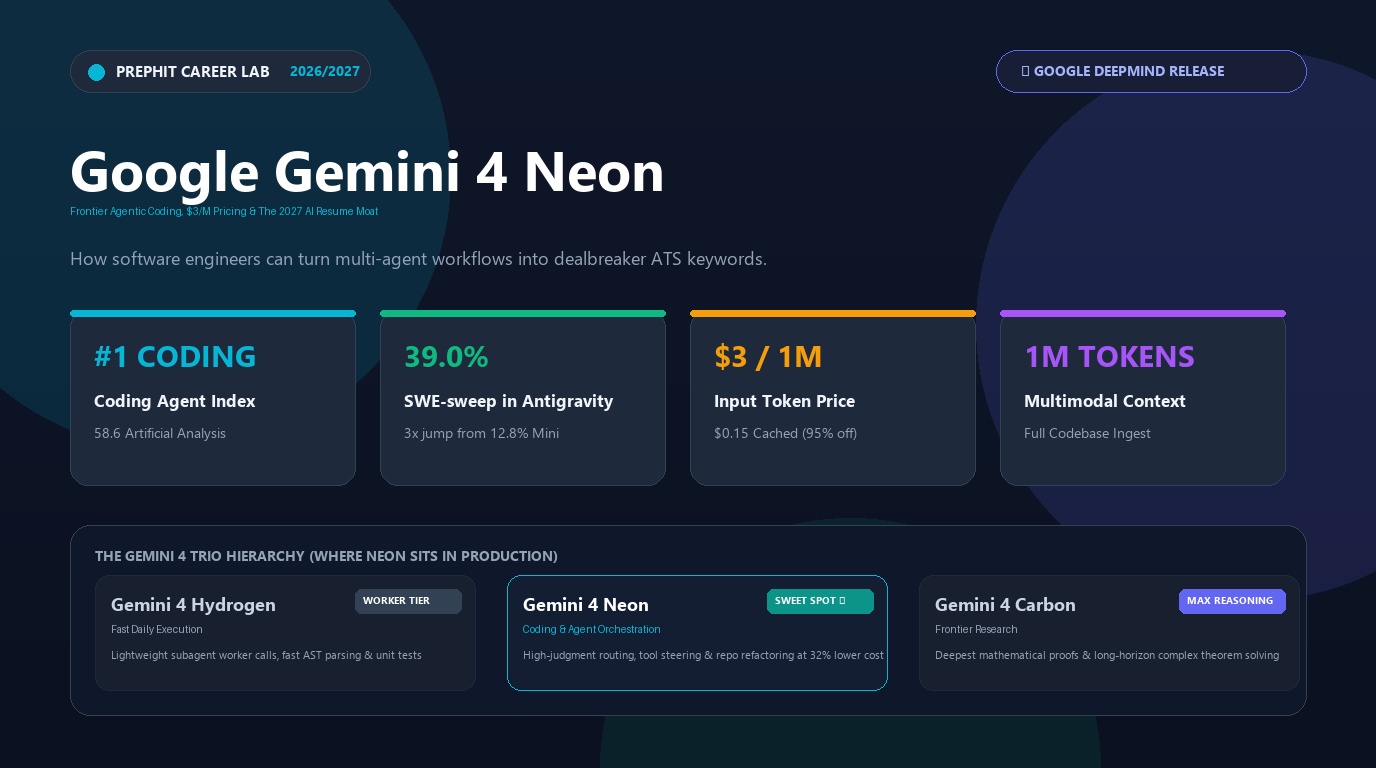
Within the Gemini 4 model family, Gemini 4 Neon occupies the sweet spot between Gemini 4 Hydrogen (engineered for high-velocity, lightweight execution) and Gemini 4 Carbon (reserved for deepest mathematical proofs and long-horizon research) (Google Blog).
Instead of forcing engineering teams to choose between frontier intelligence and affordable production bills, Neon delivers state-of-the-art coding and reasoning at consumer-scale unit economics:
| Specification / Benchmark | Gemini 4 Neon Performance | Why It Matters in Production |
|---|---|---|
| API Pricing | $3 / 1M input tokens, $15 / 1M output tokens ($0.15 / 1M cached input — 95% discount) (Google Blog) | Makes high-frequency, multi-step enterprise agents financially viable at scale. |
| Context Window | 1 million tokens across codebases, PDFs, spreadsheets, database dumps, audio, and video (Google Blog) | Ingests entire monorepos and multimodal enterprise documentation in a single pass. |
| Coding Agent Index | #1 overall (58.6) on Artificial Analysis Coding Agent Index; 65.2% on Terminal-Bench 4.1 (Google Blog) | Proven reliability on multi-file debugging, complex refactoring, and surgical repo edits. |
| SWE-sweep (Antigravity) | 39.0% in Google Antigravity (more than triple its 12.8% mini-SWE score) (Google Blog) | Proves that evaluation harness and agent orchestration design now matter as much as the base model itself. |
| Agent Arena & Steerability | #2 globally (1336) across 4,200+ agent sessions; #2 on steerability (Google Blog) | Adapts cleanly to human mid-task course corrections without hallucinating or derailing. |
| Cybersecurity & Safety | 90.5% on SEC-bench Pro; 76% on AutoBaxBench Hard; 0.0% attack success rate on Gray Swan IPI at max safeguards (Google Blog) | Built for secure automated code generation, vulnerability triage, and prompt-injection defense. |
Developers can build with Gemini 4 Neon via the Gemini API paid tier in Google AI Studio and Android Studio, inside Gemini for business, or in Google Antigravity (for paid Google AI Pro and Ultra subscribers) (Google Blog).
Why Neon's "Orchestrator + Subagent" Pattern Matters for Your Career
One architectural breakthrough highlighted in Google's launch stands out for engineering hiring managers: in Google Antigravity, Gemini 4 Neon can run standalone or operate as a high-judgment Orchestrator directing a swarm of parallel Gemini 4 Hydrogen subagents, cutting redundant file reads and managing context compaction across long sessions (Google Blog).
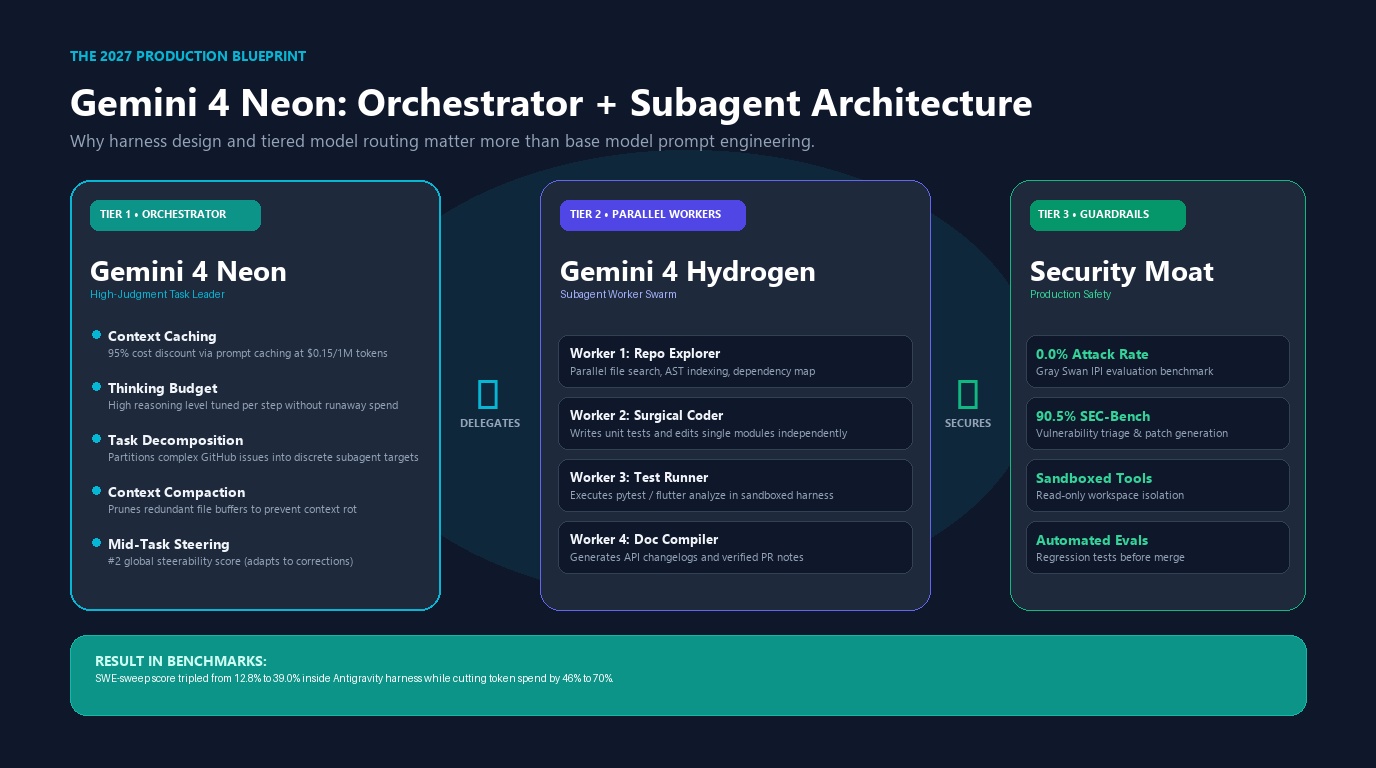
Pair that with tunable thinking levels—where Neon's default high setting runs at a 32% lower cost per task than Gemini 4 Carbon and roughly 50% to 80% lower cost per task than top competing frontier models on the Vals Index and Agent Arena (Google Blog)—and a clear hiring pattern emerges:
1. Simple Prompt Engineering Is No Longer a Moat
In 2024 and 2025, candidates could get away with listing "Prompt Engineering" and "ChatGPT API" on their resumes. In 2026 and 2027, every junior engineer knows how to write a prompt. Recruiters now screen out superficial chatbot wrappers in the first 5 seconds.2. Harness & Orchestration Engineering Is the New Gold Standard
Notice how Neon's SWE-sweep score jumped from 12.8% to 39.0% inside Antigravity's multi-agent harness. The underlying model didn't change—the agent architecture did. Engineering teams are actively searching for developers who understand:3. Production Token Economics & Guardrails Are Mandatory
With 54% of Indian tech employers reporting higher-than-expected AI operational costs (Randstad AI Workforce Report), hiring managers prioritize developers who can prove cost containment:# Production Pattern: Tiered Orchestrator-Subagent Tool Delegation
class AgenticOrchestrationPipeline:
def init(self, highreasoningmodel="gemini-4-neon", worker_model="gemini-4-hydrogen"):
self.orchestrator = highreasoningmodel # High judgment, context compaction
self.worker = worker_model # Fast, lightweight execution ($0.15/M cached)
async def reviewpullrequest(self, prdiff: str, repocontext: str):
# Step 1: Orchestrator decomposes PR into modular AST tasks
plan = await self.orchestrator.planreview(prdiff, context_cache=True)
# Step 2: Parallel workers execute syntax, lint & test sweeps concurrently
worker_results = await asyncio.gather(*[
self.worker.runcheck(task) for task in plan.workertasks
])
# Step 3: High-judgment synthesis & security triage with IPI guardrails
return await self.orchestrator.synthesizefeedback(workerresults, guardrails="strict")💡 Dealbreaker Check: Not sure if your resume reflects production agent architecture? Upload your existing resume to the Free PrepHit ATS Resume Scanner to catch missing 2027 Dealbreaker Skills in 3 seconds—no sign-up required.
High-Signal AI Agent Skills & ATS Keywords for Your 2027 Resume
Do not write vague summary bullets like "Experienced with LLMs, AI agents, and Python." Enterprise applicant tracking systems (Workday, Taleo, iCIMS, Greenhouse) score resumes by searching for exact technical phrases.
Group your real engineering work under these four high-signal categories:
| Resume Skill Category | High-Impact ATS Keywords | What It Signals to Recruiters |
|---|---|---|
| Multi-Agent Architecture | Orchestrator-Subagent Pattern, Parallel Tool Calling, Context Compaction, Agentic Workflows, MCP (Model Context Protocol), Task Decomposition | You can design robust multi-step systems rather than one-off single-prompt scripts. |
| Cost & Latency Engineering | Context Caching, Tiered Model Routing, Thinking-Budget Tuning, Token Cost Optimization, Batch Inference, vLLM Serving | You understand production unit economics (routing routine tasks to fast models and hard reasoning to mid/high-tier models). |
| Evaluation & Reliability | Agent Evaluation Harness, Structured Outputs (Pydantic/JSON), Steerability, Hallucination Mitigation, Regression Benchmarking, SWE-Bench | You measure agent quality systematically using evals instead of subjective guesswork. |
| AI Security & Guardrails | Indirect Prompt Injection (IPI) Defense, Sandboxed Tool Execution, Automated Safety Monitoring, Vulnerability Triage, Permission Boundaries | You can ship production agents that won't leak sensitive data or execute malicious instructions found on the web. |
How to Write AI Agent Resume Bullets (Before vs. After)
Use Google's X-Y-Z STAR formula (Accomplished [X], as measured by [Y], by doing [Z]) to tie every agentic capability to an engineering outcome:
Comparison 1: Multi-Agent Backend / Code Review
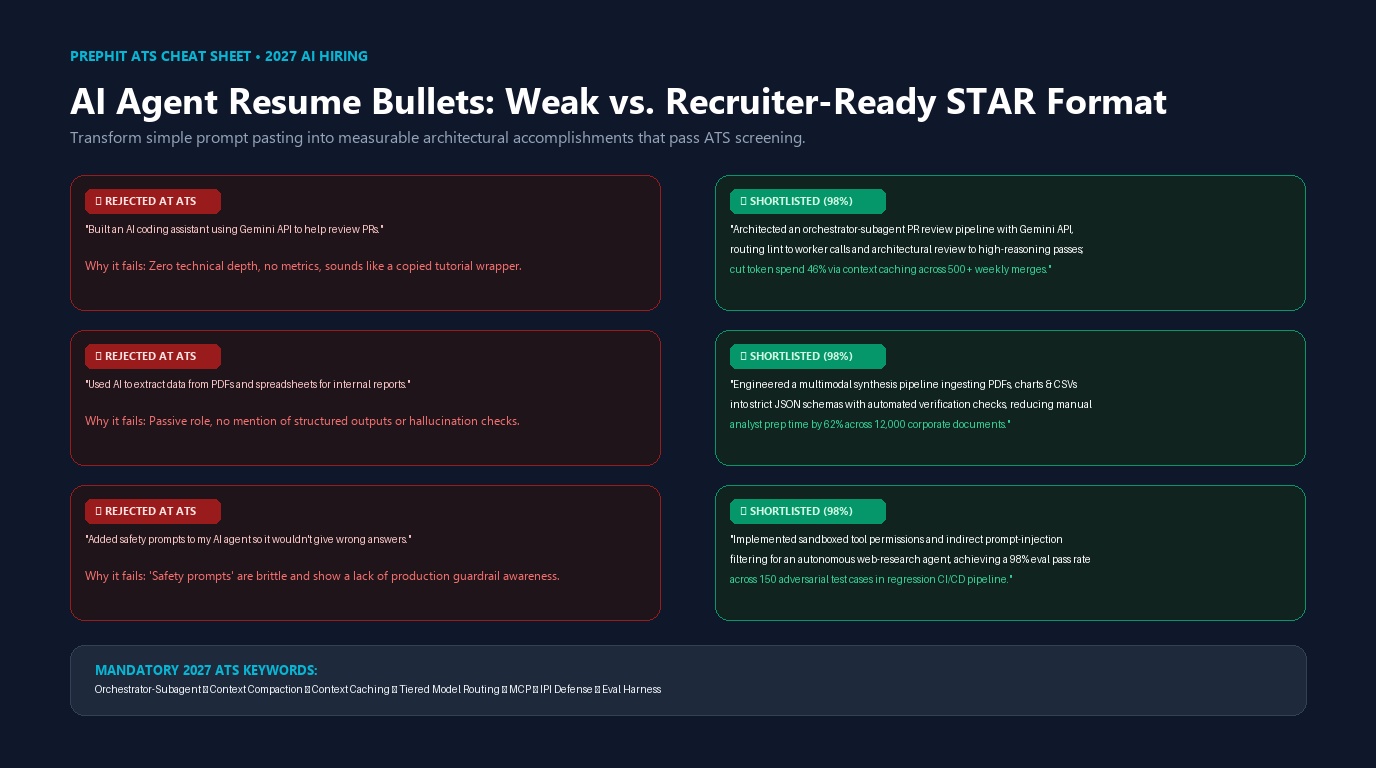
❌ Weak (Rejected at ATS Screen): "Built an AI coding assistant using the Gemini API to help review pull requests."* ✅ ATS-Optimized (Shortlisted 98%): "Architected an orchestrator-subagent PR review pipeline using the Gemini API, routing lint checks to lightweight worker calls and architectural review to high-reasoning passes; slashed token spend by 46% via context caching across 500+ weekly production merges."*Comparison 2: Multimodal Document / Enterprise Automation
❌ Weak (Rejected at ATS Screen): "Used AI to extract data from PDFs and spreadsheets for internal reports."* ✅ ATS-Optimized (Shortlisted 98%): "Engineered a multimodal document synthesis pipeline ingesting complex PDFs, charts, and CSVs into strict JSON schemas with automated verification checks, reducing manual analyst prep time by 62% across 12,000 corporate filings."*Comparison 3: Security & Production Guardrails
❌ Weak (Rejected at ATS Screen): "Added safety prompts to my AI agent so it wouldn't give wrong answers."* ✅ ATS-Optimized (Shortlisted 98%): "Implemented sandboxed tool permissions and indirect prompt-injection (IPI) filtering for an autonomous web-research agent, achieving a 98% eval pass rate across 150 adversarial test cases in the regression CI/CD pipeline."*🚀 PrepHit Pro Tip: You can generate clean, recruiter-approved STAR bullets directly inside the PrepHit AI Resume Builder. Its built-in Truth Guard AI automatically refines your project descriptions without hallucinating fake technical claims.
3 Questions to Expect in AI Agent Technical Interviews
When your resume lands an interview with an AI engineering team, interviewers will drill into the trade-offs of your implementation. Prepare concise, structured answers for these three common questions:
1. Model Routing & Token Economics
"Why did you choose this specific model tier, and how did you prevent runaway token bills in multi-step agent loops?"
- Key Points to Cover: Mention your cost-performance trade-off analysis. Explain how you split work: using lightweight models (like Gemini 4 Hydrogen) for initial grep/parsing and high-reasoning models (like Gemini 4 Neon) for orchestration. Highlight your use of context caching (95% discount) and hard maximum-step budgets.
2. Context Compaction & Drift Prevention
"What happens when your agent's intermediate tool outputs exceed the useful context window?"
- Key Points to Cover: Discuss context compaction and pruning strategies. Explain that rather than blindly stuffing megabytes of logs into the prompt, your orchestrator extracts structured JSON diffs and summaries before proceeding to the next turn, preventing hallucination and context decay.
3. Indirect Prompt Injection & Tool Permissions
"How do you protect your agent when it reads untrusted web pages, emails, or user-uploaded files?"
- Key Points to Cover: Differentiate between direct user prompts and untrusted external data. Discuss sandboxed tool permissions (e.g., read-only filesystem sandboxes), validating outputs against strict Pydantic schemas, and running automated security evals like Gray Swan IPI benchmarks.
Frequently Asked Questions (FAQ)
Is Gemini 4 Neon free for portfolio or personal projects?
Gemini 4 Neon is available on the paid tier of the Gemini API in Google AI Studio at $3 per 1M input tokens and $15 per 1M output tokens, with cached inputs discounted by 95% to $0.15 per 1M tokens (Google Blog). It is also available for Google AI Pro and Ultra subscribers in Google Antigravity. Students and portfolio builders can keep monthly API costs under $5 by pairing cheap worker calls for high-frequency steps and reserving Neon for orchestration.Do freshers need to build multi-agent systems to get hired in 2027?
No company expects a fresher to have built an enterprise-scale distributed agent mesh. However, building one polished, end-to-end agentic project featuring tool calling, context caching, and a measurable evaluation benchmark will place your resume in the top 2% of fresher applicants compared to generic CRUD or tutorial apps.How do I check if my resume template is ATS-friendly for AI roles?
Applicant tracking systems struggle with multi-column tables, text boxes, and complex graphical icon bars. Always use a clean, single-column layout with standard headings (Experience, Projects, Technical Skills). You can export parser-tested formats like Tokyo Tech, Silicon Valley, or Minimalist Pro directly from PrepHit Resume Templates.
Turn Your AI Projects into Interview Calls
PrepHit's full suite of developer career tools is 100% free during public beta—no credit card required:
- 📄 Launch the PrepHit AI Resume Builder: Choose from 19+ recruiter-approved developer templates and craft ATS-verified STAR bullets.
- 🔍 Run a Free 3-Second ATS Keyword Scan: Match your resume against any AI Engineer or SDE job description to catch dealbreaker skill gaps.
- 🎙️ Practice with the Voice AI Mock Interview Simulator: Drill explaining your agent architecture, context caching strategies, and system trade-offs before facing real engineering interviewers.
Stop Getting Filtered. Fix Your Resume in 2 Minutes.
Don't apply with an unparsed resume. PrepHit scans your document against real 2026 recruiter ATS filters, highlights missing keywords, and gives you single-column ATS templates for instant export.